From Tang China to the French Suits: Assembling the 52-Card Deck
Nobody designed the modern deck. It accumulated, over roughly six centuries and four civilisations, and the pieces are still visible.
· 10 min read
Nobody sat down and designed the fifty-two card deck. It arrived in pieces, over roughly six centuries, from China through the Islamic world into Europe and then across the Atlantic, and every stage left something behind that is still in your hands when you cut a deck. The thirteen ranks, the four suits, the corner index and the joker each have a different origin and a different date.
China, ninth century
Playing cards were most likely invented during the Tang dynasty around the ninth century, as a consequence of woodblock printing technology — cards became possible when cheap repeated images became possible. The earliest documented instance of gameplay is startlingly specific: two gamblers caught with paper cards on 17 July 1294.
Mamluk Egypt, and the deck in the Topkapı Palace
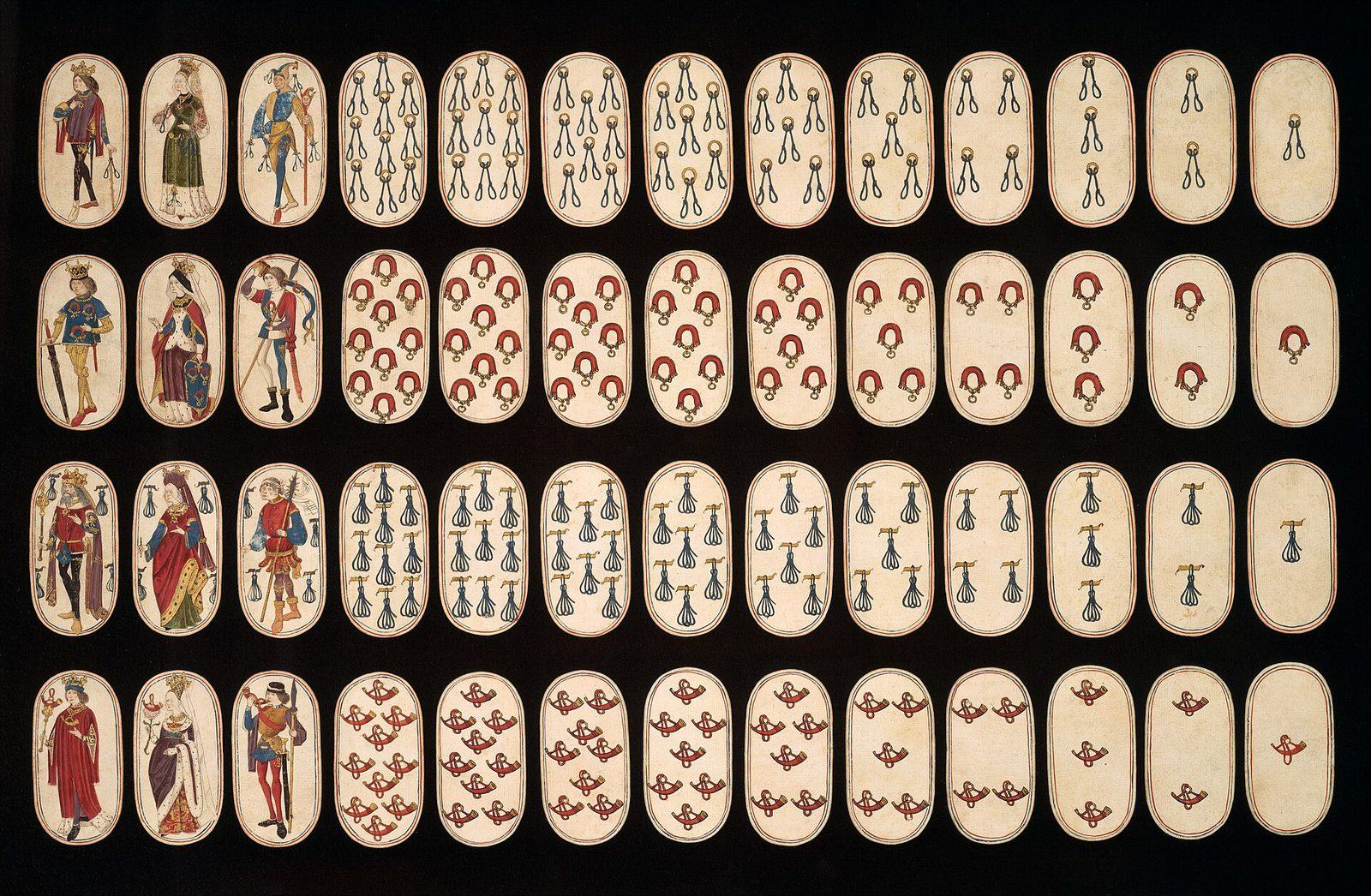
The oldest surviving cards date from the twelfth and thirteenth centuries and come from Egyptian collections. The decisive object, though, is a near-complete fifteenth-century Mamluk deck found in Istanbul’s Topkapı Palace in 1939. It contains fifty-two cards in four suits: polo-sticks, coins, swords and cups.
52 cards, 4 suits
The structure of the Mamluk deck found in the Topkapı Palace in 1939 — the shape of the modern deck, already settled before it reached Europe
Wikipedia, playing card
That is the moment the argument about origins effectively ends. Fifty-two cards divided into four suits is not something Europe invented; it is something Europe received. The suits themselves survive almost unchanged in Italian and Spanish decks, where coins, cups, swords and clubs are still standard.
Europe, 1370s
The earliest European reference is a 1371 Catalan rhyme dictionary listing naip, a playing card. What follows is a rush of documentation, and most of it is prohibitions — Florence banned cards in 1377, and the record fills out across Europe from that year: Switzerland in 1377, Florence and Paris in 1380, England by 1413.
There is something worth noticing in the shape of that evidence. The reason we can date the arrival of cards so precisely is that authorities kept trying to ban them, and bans generate paperwork. The first written history of playing cards in Europe is largely a history of attempts to suppress them.
| Year | Place | Evidence |
|---|---|---|
| 1371 | Catalonia | Rhyme dictionary lists “naip”, a playing card |
| 1377 | Florence | Prohibition on card play |
| 1377 | Switzerland | Documented reference |
| 1380 | Florence and Paris | Documented references |
| 1413 | England | Documented reference |
| c. 1480 | France | French suits simplified from the German ones |
Dates from the Wikipedia article on playing cards. The clustering around 1377–1380 is the point: cards spread across Europe in a single decade.
France, around 1480: the innovation that won
German makers used hearts, bells, leaves and acorns — pictorial suits requiring several colours and careful registration. Around 1480 French manufacturers simplified them into trèfles (clovers), carreaux (tiles), cœurs (hearts) and piques (pikes): the clubs, diamonds, hearts and spades still in use.
The advantage was industrial rather than aesthetic. Four flat shapes in two colours can be printed from simple stencils, which made French decks dramatically cheaper to produce than German or Italian ones. The suit system now used across most of the world won on manufacturing cost, and the fact that a spade does not look like a pike is a consequence of that simplification.
Two late additions
The corner index — the small rank and suit printed in the top corner so a hand can be fanned and read one-handed — appears on cards dated as early as 1693 but only becomes common from the late eighteenth century. The first widely distributed American deck with indices was the 1870 “Squeezers”.
The joker is younger still and is the deck’s only American component: it was invented around 1860 as a third trump for euchre. It has no ancestry in the Mamluk deck, no equivalent in the Italian or Spanish suits, and no fixed role in most games played with it today.
The games came later than the cards
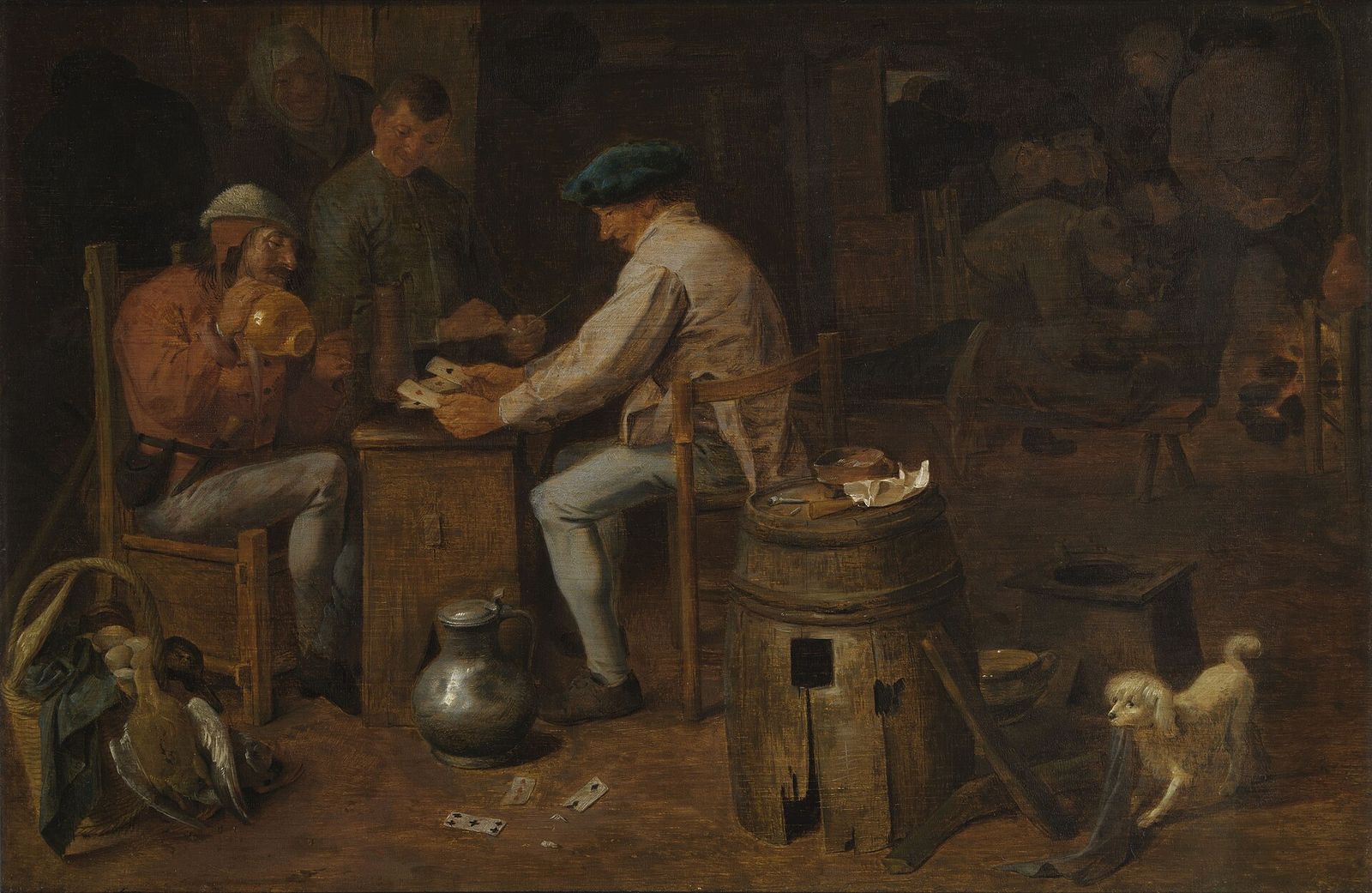
The deck predates almost everything played with it. Blackjack descends from the Spanish veintiuno — twenty-one — first documented in Cervantes around 1601–1602. It appears in Britain during the 1770s and 1780s and in France by 1888, reaches America in the early 1800s, and is only renamed “blackjack” around 1899.
Roulette, which needs no cards at all, follows a similar pattern: a gaming wheel invented in 1720 combined with the Italian game Biribi, recognisable in Paris by 1796, and given its single-zero form in 1843 by François and Louis Blanc at Bad Homburg.
| Date | Development |
|---|---|
| c. 9th century | Playing cards invented in Tang China |
| 17 July 1294 | Earliest documented instance of card gameplay |
| 12th–13th century | Oldest surviving cards, from Egyptian collections |
| 15th century | Mamluk deck: 52 cards, four suits (found 1939, Topkapı Palace) |
| 1371 | First European reference, in Catalonia |
| 1377 | Florence bans card play |
| c. 1480 | French suits: clovers, tiles, hearts, pikes |
| 1601–1602 | Veintiuno documented in Cervantes |
| 1693 | Earliest dated cards with corner indices |
| 1720 | The gaming wheel that becomes roulette |
| 1796 | Roulette in recognisable form in Paris |
| 1843 | Single-zero wheel introduced at Bad Homburg |
| c. 1860 | The joker invented, as a third trump for euchre |
| 1870 | “Squeezers”: first widely distributed indexed American deck |
| c. 1899 | Twenty-one renamed blackjack |
Compiled from the Wikipedia articles on playing cards, blackjack and roulette. Where sources disagree — as they do about baccarat’s origins in particular — the disagreement is noted in the relevant article rather than resolved here.
What survived, and why
Almost nothing in the deck was designed for the games it now serves. Fifty-two cards came from Mamluk Egypt. Four suits came with them. The specific shapes came from a French cost-cutting exercise in the 1480s. The corner index came from wanting to hold a hand in one hand. The joker came from euchre.
The result is an object of extraordinary combinatorial richness — 2,598,960 five-card hands, and 52! ≈ 8 × 10⁶⁷ possible orderings — assembled almost entirely by accident, and then discovered to be very good at supporting games nobody had thought of yet. It has not been meaningfully redesigned in five hundred years, and there is no sign that anyone needs to.