Seven Shuffles: The Mathematics of Actually Randomising a Deck
Three riffles is not a shuffled deck. The number that is has been known since 1992, and it is more than most dealers do.
· 8 min read
“Shuffled” is not a description of an action. It is a claim about a probability distribution: that every one of the deck’s 8 × 10⁶⁷ possible orderings is now about equally likely. Most of what happens at card tables does not achieve that, and for a long time nobody could say how much would.
In 1992 Dave Bayer and Persi Diaconis answered the question. The number is seven.
7 riffles
Riffle shuffles required to randomise a 52-card deck, in the precise sense of variation distance. Five is not enough — the deck barely starts to become random until then
Bayer and Diaconis, 1992, via Wikipedia
Modelling a shuffle you can actually do
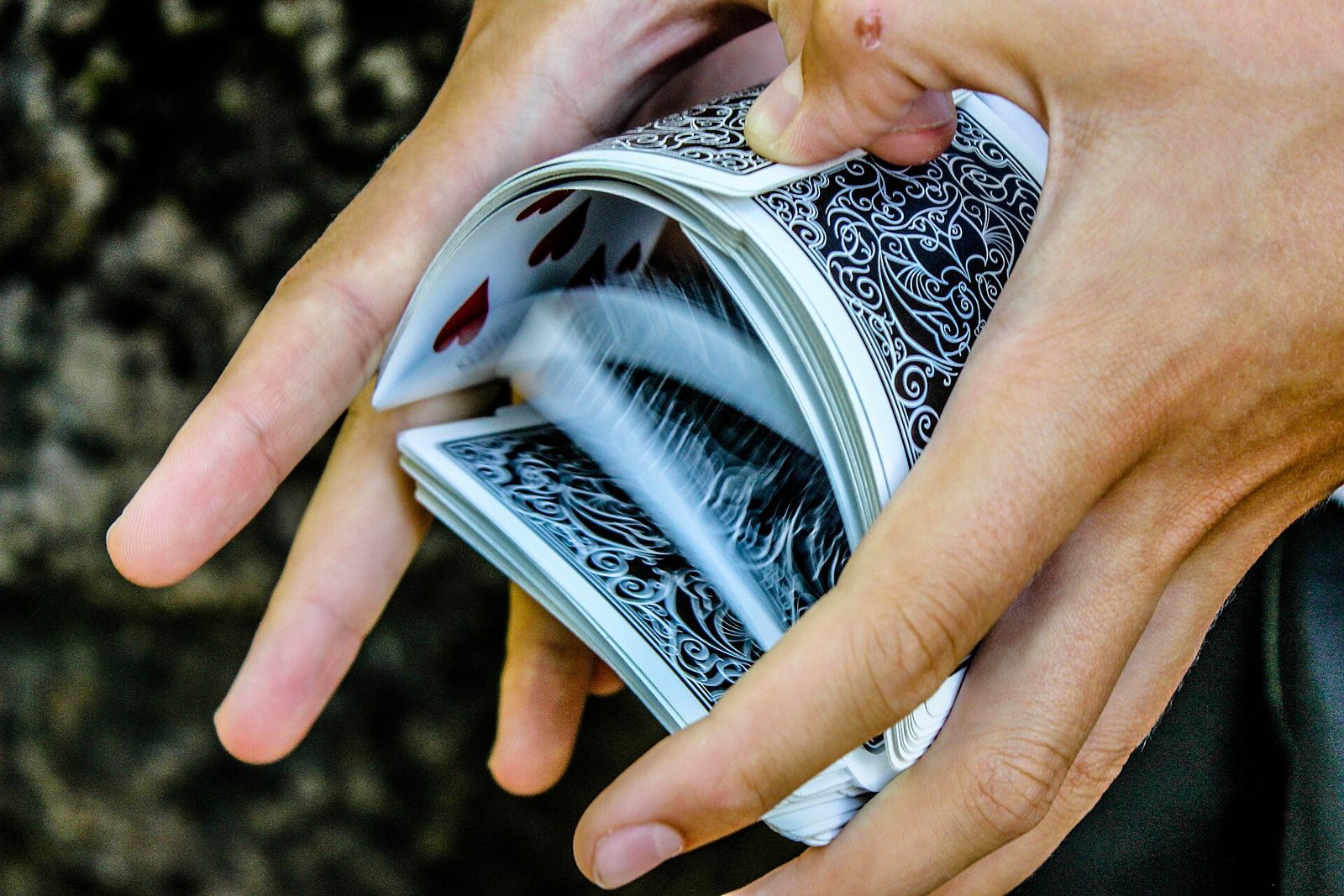
The result depends on having a mathematical description of a real human riffle, not an idealised one. That is the Gilbert–Shannon–Reeds model, which Wikipedia describes as having been shown experimentally to be a good fit to human shuffling. It splits the deck roughly in half — with the sizes themselves random — and then interleaves the two packets, dropping the next card from whichever packet is larger with correspondingly higher probability.
That last detail is what makes the model realistic. A human riffle does not alternate neatly; it drops small clumps, and it drops more from the thicker half. GSR captures both.
Measuring “random enough”
You cannot ask whether a particular arrangement is random — any specific ordering is as unlikely as any other. What you can measure is how far the whole distribution over orderings sits from the uniform one, and the standard tool is variation distance, borrowed from the study of Markov chain mixing times.
Bayer and Diaconis found that the distance stays close to its maximum for the first few shuffles and then falls off a cliff. In their words, as summarised on Wikipedia, the deck “did not start to become random until five good riffle shuffles, and was truly random after seven”.
| Riffles | State of the deck |
|---|---|
| 1–4 | Heavily ordered |
| 5 | Beginning to mix |
| 6 | Nearly there |
| 7 | Effectively random |
A plain-language rendering of the Bayer–Diaconis cutoff as described in the Wikipedia article on shuffling. The transition is genuinely abrupt — this is the behaviour that gives the result its name, a cutoff phenomenon.
The abruptness is the interesting part. Randomness does not accumulate gradually with each shuffle; it arrives almost all at once, over the space of two or three shuffles. A dealer doing four riffles and a dealer doing seven are not doing slightly different jobs. They are on opposite sides of a threshold.
The overhand shuffle barely works at all
The overhand shuffle — sliding small packets from one hand to the other — is the shuffle most people default to, and it is dramatically worse. Wikipedia cites a result putting its mixing time at Θ(n² log n) steps, against the riffle’s far smaller requirement.
For 52 cards that difference is not academic. It is the gap between seven shuffles and several thousand. An overhand shuffle moves blocks of cards rather than interleaving them, so long runs of adjacent cards survive intact through shuffle after shuffle. If a deck was sorted by suit when it went in, it is recognisably sorted by suit when it comes out.
The perfect shuffle is not a shuffle
A faro, or perfect, shuffle cuts the deck exactly in half and interleaves the cards one at a time in strict alternation. It is difficult to execute and it does the opposite of randomising: it is a deterministic permutation.
Its most famous property is a cycle. Eight consecutive perfect faro shuffles restore a 52-card deck to its original order exactly — provided the deck is 52 cards and the original top and bottom cards remain in place. A performer who can execute eight of these has returned the deck to precisely where it started, which is a magic trick, not a shuffle.
| Method | What it does | To randomise 52 cards |
|---|---|---|
| Riffle (GSR model) | Interleaves two roughly equal packets | 7 shuffles |
| Overhand | Moves small blocks intact | Θ(n² log n) — thousands |
| Faro (perfect) | Deterministic exact alternation | Never — cycles in 8 |
From the Wikipedia article on shuffling. The faro figure is the eight-shuffle cycle for a 52-card deck with the top and bottom cards held in position.
Online, the shuffle is a specification
A digital card game has no deck to riffle, and the entire question becomes a requirement on the random number generator. British standards demand that outcomes be “acceptably random”, demonstrable through statistical testing; that the generator’s output be uniformly distributed and unpredictable; that it not reproduce the same stream or synchronise between instances; and that any scaling applied preserve those qualities.
The disclosure rules go further than most players notice. RTS 3A lists, among the explanatory content that should be considered for inclusion in a game’s rules, “the number of decks or frequency of shuffles in virtual card games”. How often the virtual deck is reshuffled is treated as material information about the game — which is exactly right, because it is.
What to do with a deck at home
Seven riffles, with a cut. Not four, and not an overhand shuffle of any length. If the deck is new or was just sorted, more rather than fewer — the starting order is the thing being destroyed, and a heavily ordered start takes longer to destroy than a lightly disordered one.
It sounds fussy for a kitchen-table game and it takes about fifteen seconds. The result of skipping it is not a subtly biased deck; it is a deck that still substantially reflects the order of the last hand, which is a real advantage to anyone paying attention and no advantage at all to anyone who is not.