One Zero or Two: How a Single Pocket Doubles the Price
The bets are identical, the payouts are identical, and the wheel with one extra pocket costs you almost twice as much per spin.
· 7 min read
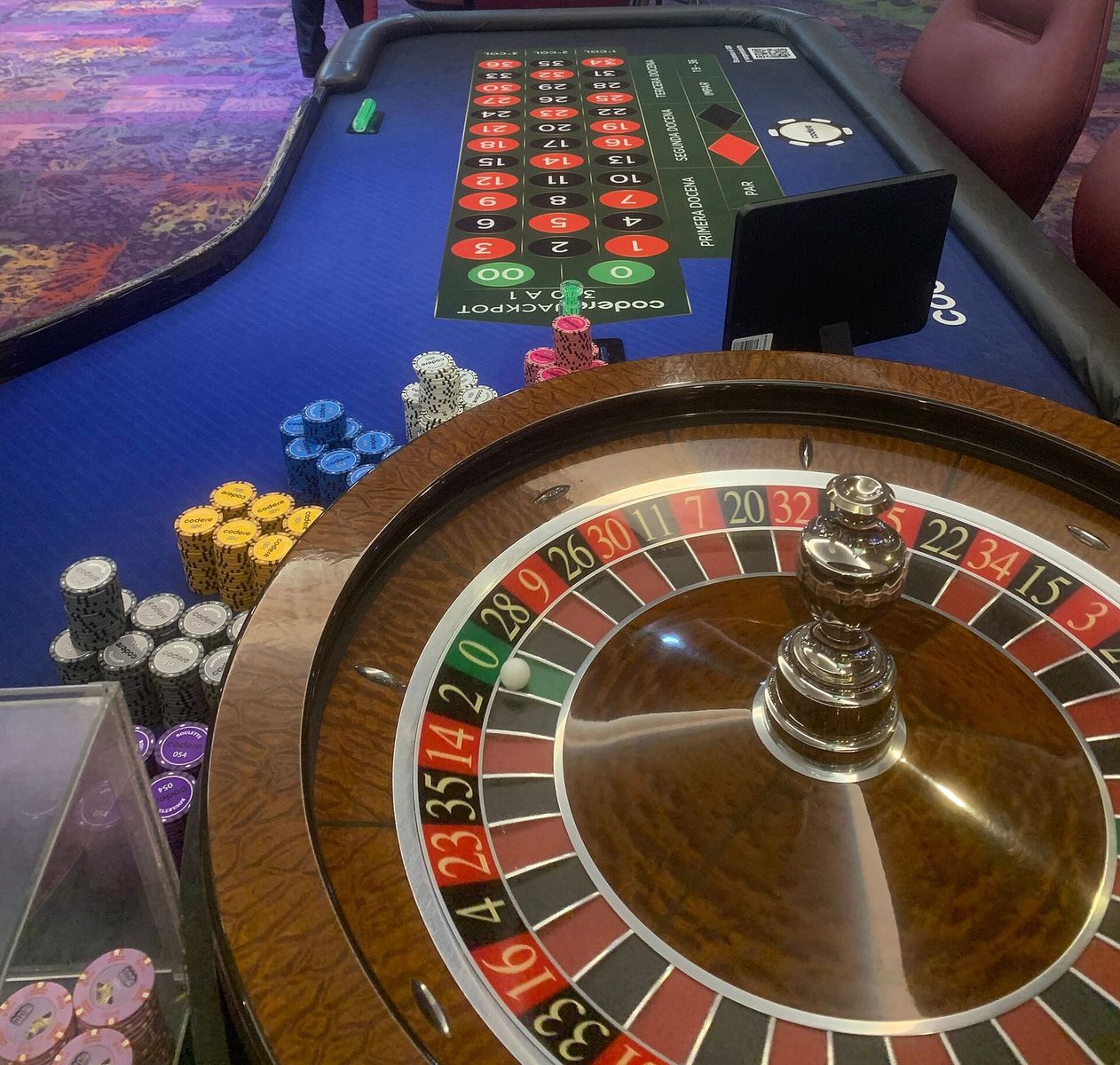
Two roulette wheels sit in the same room. They take the same bets, print the same payouts on the same layout, and spin at the same speed. One of them has an extra pocket. That pocket nearly doubles the price of playing, and nothing on the table says so.
The arithmetic of one extra pocket
A European wheel has 37 pockets: the numbers 1 to 36 and a single zero. An American wheel has 38: the same numbers plus a double zero. A straight-up number pays 35 to 1 on both.
On the European wheel, that means a payout of 35 against true odds of 36 to 1:
(1/37 × +35) + (36/37 × −1) = −0.0270
On the American wheel, the same payout against true odds of 37 to 1:
(1/38 × +35) + (37/38 × −1) = −0.0526
2.70% vs 5.26%
House edge on a single-zero wheel against a double-zero wheel — the same bets, the same payouts, and 95% more cost per spin
Wikipedia, Roulette; Wizard of Odds house-edge tables
Every bet on either wheel carries its wheel’s edge, with one exception. The five-number bet — 0, 00, 1, 2, 3, available only on the American wheel — pays 6 to 1 and costs about 7.89%, making it the single worst bet in roulette and the only one that manages to be worse than the wheel it sits on.
The payouts, which are identical either way
| Bet | Numbers covered | Payout | Edge (single zero) | Edge (double zero) |
|---|---|---|---|---|
| Straight up | 1 | 35 to 1 | 2.70% | 5.26% |
| Split | 2 | 17 to 1 | 2.70% | 5.26% |
| Street | 3 | 11 to 1 | 2.70% | 5.26% |
| Corner | 4 | 8 to 1 | 2.70% | 5.26% |
| Six line | 6 | 5 to 1 | 2.70% | 5.26% |
| Column / dozen | 12 | 2 to 1 | 2.70% | 5.26% |
| Red / black, odd / even, high / low | 18 | 1 to 1 | 2.70% | 5.26% |
| Five-number (American only) | 5 | 6 to 1 | — | 7.89% |
Payout odds from the Wikipedia article on roulette. Every bet on a given wheel carries the same edge because every payout is short by the same proportion — the only exception is the five-number bet.
That uniformity is worth pausing on. In craps or baccarat, choosing the right bet materially changes what you pay. In roulette it does not: spreading chips across a dozen numbers, backing red all night or hammering a single number all cost precisely the same percentage of turnover. They differ enormously in variance and not at all in price.
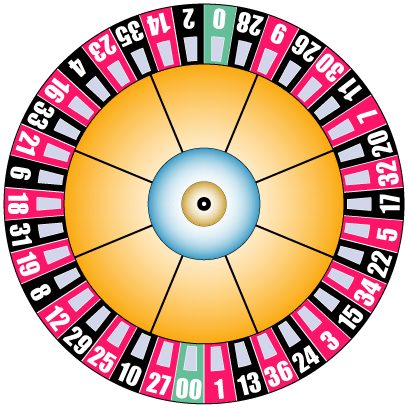
La partage and en prison: the rules that halve the edge again
French tables — and some European ones — add a rule that applies only to the even-money bets: red/black, odd/even and high/low.
Under la partage, when the ball lands in zero, an even-money bet loses only half its stake instead of all of it. Under en prison, the stake is instead held for the next spin and returned intact if that spin wins. Both rules cut the house edge on those bets to roughly 1.35%.
| Wheel and rules | Pockets | House edge on red/black |
|---|---|---|
| French, la partage or en prison | 37 | 1.35% |
| European, single zero | 37 | 2.70% |
| American, double zero | 38 | 5.26% |
| Triple zero | 39 | 7.69% |
From the Wikipedia article on roulette. The la partage figure applies only to even-money bets; every other bet on the same French wheel still costs 2.70%.
The spread from top to bottom of that table is a factor of nearly six. A player backing red at a French table and a player backing red at a triple-zero machine are playing what looks like the same game for wildly different money, and the only visible difference is how many green pockets are on the rim. Counting them takes two seconds.
Where the wheel came from
The modern wheel developed from a gaming wheel invented in 1720, combined with the Italian game Biribi, and reached recognisable form in Paris by 1796. The single-zero wheel is not the original: it was introduced in 1843 by François and Louis Blanc at Bad Homburg, specifically to undercut the double-zero wheels that everyone else was running.
Which is to say that the cheaper wheel was invented as a competitive weapon, nearly two centuries ago, and it worked. The double-zero wheel survived anyway, mostly in America, and the two have coexisted ever since at prices that differ by a factor of two.
Online, the wheel is a certified generator
A digital roulette game has no rim and no ball. The result comes from a random number generator, and in Great Britain that generator must meet published standards: outputs uniformly distributed across the range, outcomes distributed according to the theoretical probabilities, no reproducible cycles, and — stated explicitly — no adaptive behaviour. A licensed game is not permitted to respond to how you are doing.
The only decision that matters
Count the green pockets before you sit down. One is 2.70%. Two is 5.26%. Three is 7.69%. If the table is French and offers la partage, the even-money bets are 1.35% and roulette becomes a genuinely reasonably priced game. Everything else about how you bet is a question of taste, and taste is free.